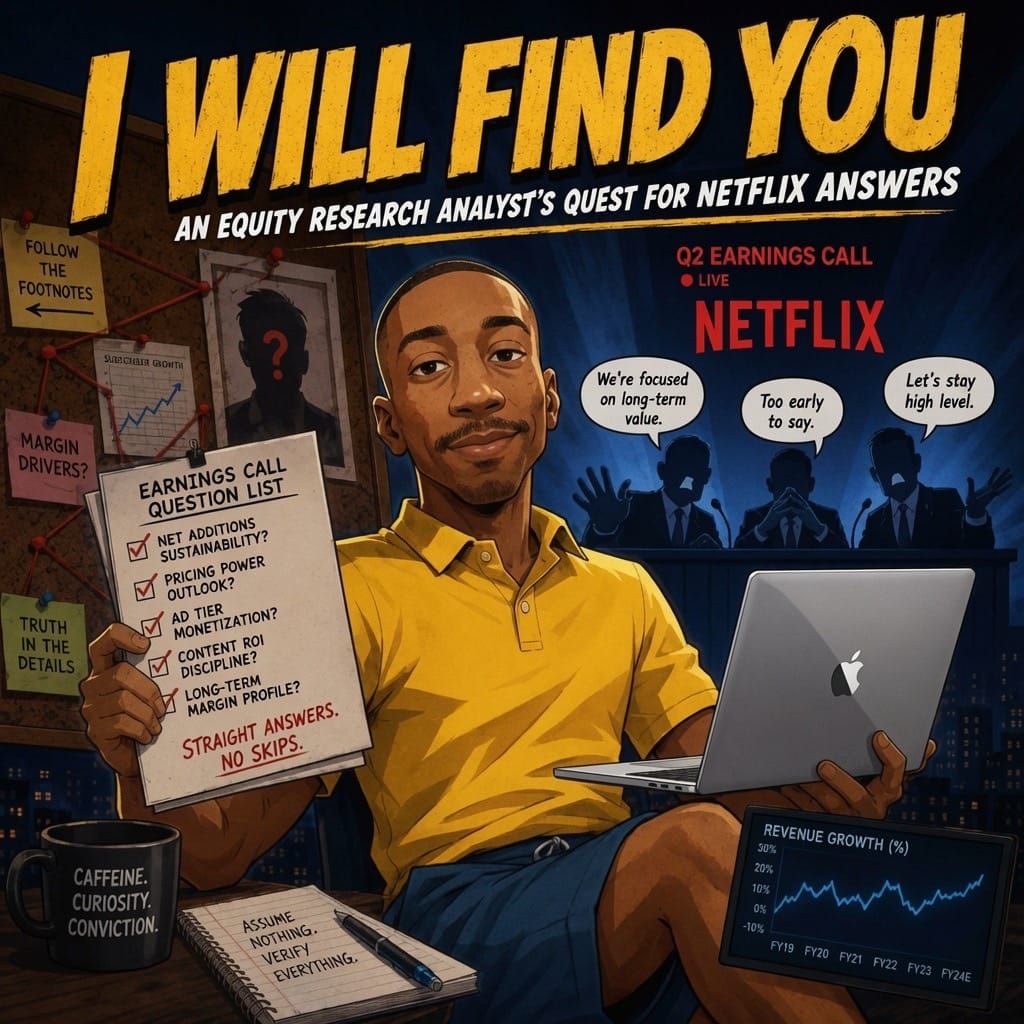
More Questions Than Answers For The Streaming King

More Questions Than Answers For The Streaming King

Our Rating: Sell

Although negative, I don't know if we'll have enough downside on the Weekly or Monthly chart left to short. But it's not out of the realm of the possibility the stock tests the low $60 range.


Disclaimer: Every single investment related statement on this site from Rising Advantage, LLC or anyone acting on its behalf is provided for general informational and educational purposes only and does not constitute any personalized investment, financial, legal, or tax advice. The information presented is not tailored to the objectives, financial situation, or needs of any specific individual. Investing involves risk, including the possible loss of principal. You should conduct your own due diligence and / or consult with a licensed financial professional before making any investment decision. Past performance is not indicative of future results.

Netflix’s second-quarter 2026 earnings call presented a company that remains highly profitable, globally dominant and operationally disciplined. That said, we think the quarter reiterated that Netflix is firmly positioned in the slow but stable phase of its growth cycle. The typical seasonally weak Q2 failed to provide the kind of accelerating growth or upward guidance revision that investors typically expect from a company carrying premium expectations.

Netflix generated $12.56 billion in second-quarter revenue, representing year-over-year growth of 13.4 percent. Diluted earnings per share reached $0.80, slightly exceeding the consensus estimate of $0.79, while revenue came in modestly below expectations. Operating income increased 11 percent to $4.19 billion, but that growth rate lagged revenue growth. Operating margin declined to 33.4 percent from 34.1 percent in the comparable quarter. The results were close to management’s forecast, but not enough to reassure investors looking for another meaningful upside surprise. 

The most concerning aspect of the report was the visible deceleration in sequential revenue growth. Netflix grew revenue by 16.2 percent in the first quarter, 13.4 percent in the second quarter and expects growth to slow further to 11.7 percent in the third quarter. On a foreign-exchange-neutral basis, growth is expected to fall from 12 percent in the second quarter to 11 percent in the third. Management attributed some of the slowdown to difficult comparisons and the timing of last year’s growth, but the broader direction is worth watching.

Netflix expects third-quarter revenue of $12.86 billion and diluted earnings per share of $0.82. The Street had been looking for approximately $13 billion in revenue and earnings of $0.84 per share. The disappointing forecast caused Netflix shares to fall 8.6% in the after hours following earnings reflecting continuing concern that Netflix’s mature subscription business may no longer be capable of consistently producing the upside surprises that supported its elevated valuation.

Management narrowed its full-year revenue forecast to between $51 billion and $51.4 billion, compared with its previous range of $50.7 billion to $51.7 billion. Although the new range provides greater certainty, its midpoint remained effectively unchanged. Netflix also maintained its full-year operating margin target of 31.5 percent rather than raising it. A more bullish report would likely have included a higher revenue midpoint, a larger margin target or stronger third-quarter guidance. Instead, investors received a narrower range that confirmed the existing plan but offered little evidence of accelerating momentum. Cash generation also weakened considerably during the quarter. Free cash flow fell to approximately $1.53 billion from $2.27 billion a year earlier, while operating cash flow declined to $1.74 billion from $2.42 billion. Netflix attributed part of the decline to higher cash tax payments associated with the Warner Bros. termination fee. Management continues to expect approximately $12.5 billion in full-year free cash flow, but the second-quarter decline demonstrates how reported earnings and actual cash generation can diverge substantially from quarter to quarter. 

Engagement produced another source of concern. Netflix members watched more than 97 billion hours during the first half of 2026, an increase of only 2 percent from the previous year. That was slightly better than the 1.5 percent growth reported for 2025, but it remains modest compared with the company’s revenue growth and the expansion of its content offering. Netflix is serving approximately 330 million subscription households and says its audience is approaching one billion people, yet total viewing hours are barely growing, emblematic of price increases, advertising and household additions are doing considerably more work than increased engagement.

Analysts directly questioned management about softening viewing hours per member. Management opined that viewing hours do not have a linear relationship with revenue because different categories of content produce different economic benefits. Management pointed to live programming as an example. Netflix expects live content to consume slightly more than 5 percent of its content spending while producing only about 1 percent of viewing hours. The company believes live events justify that imbalance because they generate sign-ups, advertising revenue, publicity and fan engagement. However, Netflix is asking investors to accept weaker traditional engagement metrics while trusting internal measurements that it will not disclose, and we believe that is a core reason while Netflix shares may be in the penalty box in the short to medium term. Management said the company has developed proprietary quality metrics but declined to explain them because Netflix considers them a competitive advantage. Management may possess legitimate evidence that subscriber satisfaction remains high, but investors cannot independently verify those claims.

Netflix''s lack of transparency is like having bad meals at a restaurant and the chef tells you not to worry while they refuse to tell you the ingredients they're putting in your next meal. That's a core reason the stock is down. Investors have questions and the answers aren't good enough.

That problem is magnified by Netflix’s decision to publish its “What We Watched” report only once a year beginning in 2027. The company already stopped providing quarterly subscriber numbers in 2025. Netflix says the reporting change is intended to keep attention on revenue and operating profit, but the timing is questionable. Subscriber reporting disappeared as the business matured, and engagement reporting is now being reduced while viewing growth remains subdued. We think Netflix is becoming less transparent precisely when investors need more information to determine whether revenue growth is coming from genuine increases in customer value or repeated monetization of an increasingly mature audience.

Rising Advantage, llc
CTA Image

Want To Learn How to Trade? Subscribe to The Rising Advantage Trading Mentorship To Learn a Timeless and Valuable Skill

Subscribe to Our Trading Mentorship

Advertising remains Netflix’s most credible new growth engine, but the discussion revealed that the business is still underdeveloped. Netflix expects approximately $3 billion of advertising revenue in 2026, roughly double the previous year. That is significant growth, but it represents less than 6 percent of the company’s projected annual revenue. More importantly, management acknowledged that average revenue per membership on the advertising plan remains below the average generated by the standard ad-free plan. Netflix must improve fill rates, measurement, targeting, programmatic access and advertiser demand merely to close that monetization gap. 

This means the advertising opportunity should not be treated as fully proven. Netflix has a large audience and valuable inventory, but it is building an advertising technology operation in a market where Alphabet, Amazon, Meta and other established players possess years of data, infrastructure and advertiser relationships. Netflix may ultimately become a major advertising platform, but the call showed that considerable execution is still required before the ad tier generates economics comparable to the company’s traditional subscription products. It does remain a long-term catalyst, but it's a five year + catalyst, not a 12 month catalyst.

Pricing continues to play a major role in the financial story. Management said recent price increases in the United States, Mexico and Spain were performing in line with expectations and that retention remained strong. Netflix clearly possesses pricing power, but continued dependence on price increases can become dangerous when engagement per member is not expanding meaningfully. Without regular subscriber disclosures, investors cannot easily determine how much of revenue growth is coming from new households, how much is coming from higher prices and how much represents advertising revenue. 

Netflix is also experimenting with free trials, discounted introductory periods and complimentary upgrades in selected markets. Management described these programs as part of its normal testing process, but their return may indicate that customer acquisition is becoming more difficult. Mature businesses frequently rely on promotions when organic penetration becomes harder to achieve. Netflix says it is still less than 45 percent penetrated among approximately 800 million addressable households, but converting the remaining households may require lower prices, more localized content and greater marketing expense than converting the company’s existing customer base. 

We believe advertising must materially increase in the long run for Netflix's stock to continue giving the bulls reasons to own the stock. At the same time, the company must balance price increases without damaging retention and competing with YouTube and other traditional media companies. There are no near-term catalysts and we are negative on the company's stock over the next 12 months at this current juncture. Sexi service when it wants to be, but not a sexi stock right now.